Loading...
HomeFamily Law

How We Help
Child Support in Thailand.
Court orders, enforcement by salary garnishment and asset seizure, and cross-border recovery when the paying parent has left Thailand. We represent both paying and receiving parents.
How We Work
From First Contact to Enforcement
01
We Assess Your Position Before Anything Else
We review your full situation — existing arrangements if any, the child's current needs, the other parent's known income and assets, and whether you are seeking to recover, establish or defend against a support obligation. We give you a realistic assessment of what the court is likely to order and what enforcement tools apply to your case before a single document is filed.
02
We Build the Evidence
Strong submissions produce better outcomes. We work with you to compile the child's actual monthly expenses — school fees, medical costs, housing, transport — alongside documented evidence of the paying parent's income, business interests and assets. Where asset disclosure is incomplete, we advise on the legal tools available to compel it. Courts award support based on evidence, not estimates.
03
We Act — Agreement, Court or Both
Where both parents agree, we document the arrangement and register it at the District Office, making it legally binding without a court hearing. Where agreement cannot be reached, we prepare and file the Family Court application, present the evidence and represent you at the hearing. We handle the court process end to end — you do not navigate it alone.
04
We See It Through to Enforcement
Obtaining an order is not the end. Where the paying parent defaults — in Thailand or abroad — we move immediately to enforcement. Salary garnishment, bank attachment and asset seizure in Thailand. For a paying parent who has left the country, we engage correspondent lawyers in the relevant jurisdiction and manage the international coordination with a clear strategy and realistic timeline.
What We Do
Scope of Work
Child Support Advice — Both Sides, Any Stage
We advise both receiving and paying parents from the earliest stage. Whether you are establishing a support obligation for the first time, defending a claim you consider disproportionate, or trying to enforce an order that is being ignored — we assess your position and advise on the realistic range of outcomes before recommending a course of action.
Q — Do you represent paying parents as well as receiving parents?
Yes. We represent both sides with the same commitment to a documented, fair outcome. For paying parents we advise on their actual obligations under Thai law, defend against disproportionate claims and apply for variation where income has genuinely changed. A fair outcome is more durable than one that leaves either side feeling wronged.
Agreed Arrangements and District Office Registration
Where parents agree on an amount, we draft the arrangement and register it at the District Office as part of divorce documentation. This makes it legally binding and enforceable without a court hearing. We build variation mechanisms into every agreement we draft so that changed circumstances — income change, custody change, the child's changing needs — can be addressed without returning to court.
Q — Do we need to go to court if we both agree?
Not necessarily. Agreed arrangements can be documented and registered at the District Office as part of divorce proceedings — legally binding and enforceable without a court hearing. We build variation mechanisms into every agreement so that changed circumstances can be addressed without starting fresh proceedings. An informal, unregistered agreement is not enforceable.
Family Court Applications — Contested Support
Where parents cannot agree, we prepare and file a child support application with the Thai Family Court. We compile the full submission — the child's monthly expenses, standard of living before separation, education costs, medical needs — and represent you at the hearing. The court issues a binding order. Non-compliance is contempt of court, and we pursue enforcement immediately.
Q — What happens if the paying parent ignores a court order?
Non-compliance is contempt of court. We pursue enforcement through salary garnishment orders directed at the employer, bank account attachment and, where necessary, asset seizure and forced sale. Persistent non-compliance can result in fines and imprisonment. The court has broad powers once an order is in place — and we use them.
Enforcement in Thailand
When a paying parent in Thailand defaults, we pursue enforcement through salary garnishment orders directed at the employer, bank account attachment, and asset seizure and forced sale where necessary. Each mechanism requires a court order — where one does not yet exist, obtaining it is the first step. We do not wait for the other parent to start paying voluntarily.
Cross-Border Enforcement
When a paying parent leaves Thailand, enforcement requires international coordination. A Thai Family Court order is the essential instrument. We work with correspondent lawyers in the UK, Australia, the US, Germany and Scandinavia to register and enforce Thai orders in the foreign jurisdiction where the paying parent is now living. Assets retained in Thailand can be enforced against directly regardless of where the paying parent resides.
Q — Can you enforce against a father who has returned to the UK?
Yes. A Thai Family Court order is the starting point. We coordinate with specialist family law firms in the UK to register and enforce the Thai order through the English courts. The process takes time, but it works. We have recovered arrears in multiple jurisdictions for clients who were told the paying parent was beyond legal reach.
Variation Orders
Either parent can apply to the Family Court to vary an existing child support order where circumstances have materially changed — a genuine reduction in income, a change in the child's needs or a change in custody arrangement. We prepare and file variation applications and represent clients at the variation hearing. We also defend against variation claims brought on grounds that do not represent a genuine material change.
Q — How long does the enforcement process take?
Domestic enforcement — salary garnishment or bank attachment in Thailand — typically takes four to eight weeks once a court order is in place. Cross-border enforcement depends on the foreign jurisdiction. We give clients a realistic timeline at the outset based on the specific country involved.
Our Commitment
What You Can Expect from Us
We Represent Both Paying and Receiving Parents with the Same Commitment
We do not take an institutional position on which side of a child support dispute is more sympathetic. We take your case and pursue your position — whether that is recovering unpaid support, obtaining an initial order or defending against a claim that is out of proportion to what the evidence shows. A fair, documented outcome is more durable than one that leaves either side with a grievance.
Documentation First — No Informal Arrangements
Every support agreement we are involved in is formally documented — either registered at the District Office or ordered by the court. An informal arrangement that cannot be enforced is a liability, not a resolution. We insist on formal documentation regardless of how cooperative current relations appear to be. Circumstances change. Documentation does not.
International Reach for Cross-Border Cases
We have direct working relationships with family law firms in the UK, Australia, the United States, Germany and Scandinavia. When a paying parent leaves Thailand, we know the process in the country they have moved to and we coordinate the international enforcement steps without delay. We have recovered arrears in multiple jurisdictions for clients who were told enforcement was not possible.
The Obligation Follows the Parent — Wherever They Go
The legal obligation to support a child does not end when a parent leaves Thailand. Distance does not extinguish the obligation, and with the right legal steps, it does not defeat enforcement either. We pursue child support through every available mechanism — in Thailand and internationally — because a child's right to financial support is not subject to a geographical limit.
Who You'll Work With
Our Team
Kanokpich Ukritdutsadee
Managing Director & Lead Barrister · 21 Years Qualified
"Child support cases involving one parent abroad are among the most emotionally difficult we handle. The paying parent may believe that distance removes their legal obligation. It does not. The child's right to support does not have a geographical limit — and we pursue it accordingly."
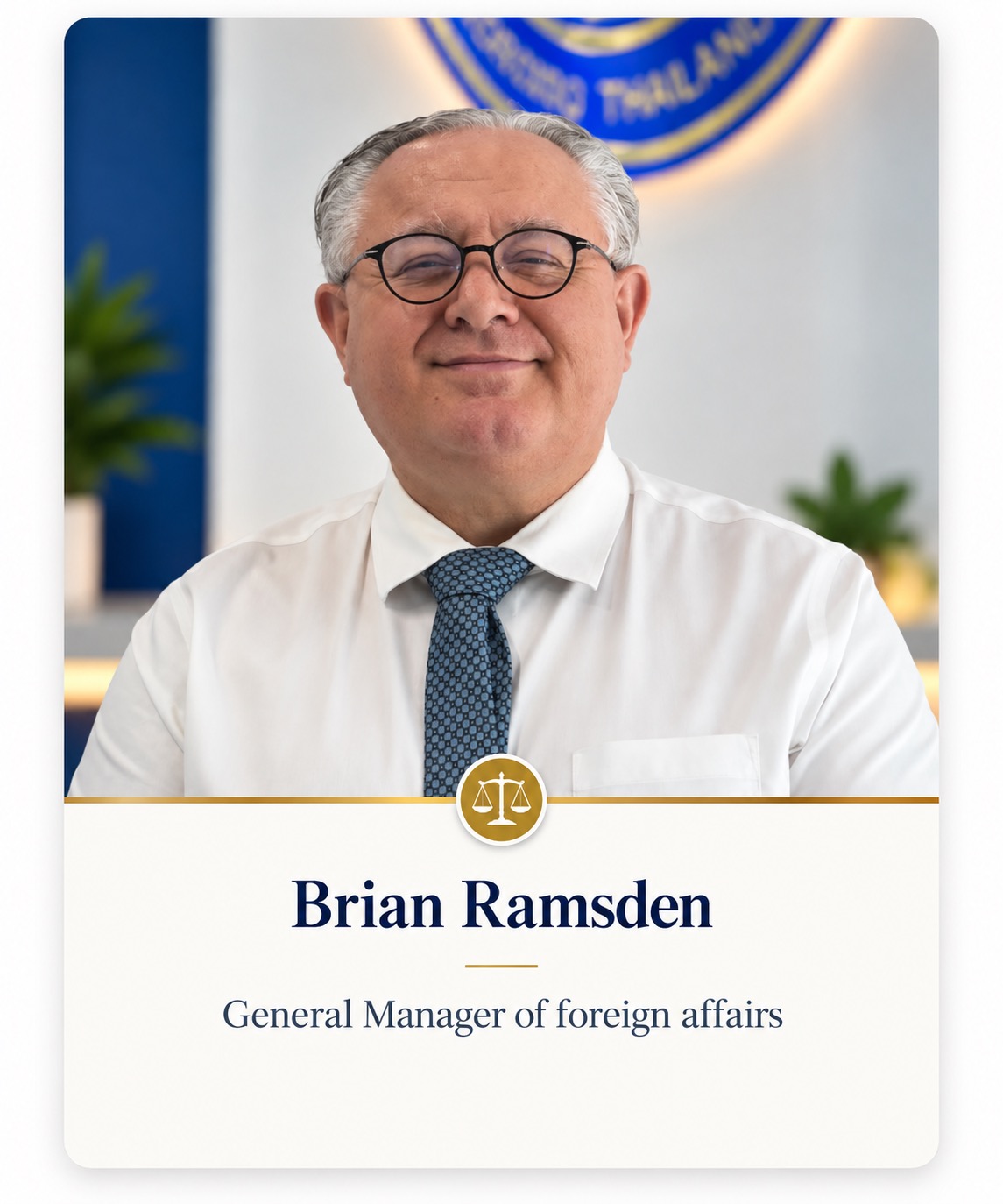
Brian Ramsden
General Manager of Foreign Affairs · DBD Ambassador
Brian coordinates all cross-border child support work — managing the international enforcement coordination with correspondent family law firms in the UK, Australia, the United States, Germany and Scandinavia. When enforcement requires steps in a foreign jurisdiction, Brian knows the process and the contacts to make it happen.
Related
Child Support Guide
→How child support is calculated, enforcement options and cross-border recovery explained in full detail.
Children & Family Rights
→Adoption, guardianship, legitimation and parental rights for expat families in Thailand.
Foreign Divorce Recognition
→How a foreign divorce order is recognised in Thailand and what follows for assets and custody.
Family Law
→All family law services — prenuptial agreements, divorce, child support, adoption and guardianship.
Lawyers for Expats Thailand — Family Law Practice. August 2026. This page does not constitute legal advice. Always obtain qualified independent legal advice for your specific circumstances.