


Land Title Deeds in Thailand

How many are there, what they mean, and the only three a foreigner
should ever consider.
Last reviewed: April 2026 | Written by Lawyer Pook, Lawyers for Expats Thailand


Introduction
Clients ask me almost every week, “How many land title deeds are there in Thailand?” The
honest answer is that it depends on how you count them — but for any foreigner investing
here, only a handful actually matter, and only three are worth your money.
This short report explains what each title means, which to accept, and which to walk away
from. If you are unsure about a deed you have been shown, do not sign anything. Call my
office first.

The Short Answer
• 1 true ownership title — the Chanote (Nor Sor 4 Jor).
• 4 main documents used in conveyancing — Chanote, Nor Sor 3 Gor, Nor Sor 3, Sor Kor 1.
• 6–7 instruments issued by the Department of Lands in total.
• 30+ types if you include land-use certificates from other agencies.
The Only Three a Foreigner Should Consider
Chanote • Nor Sor 3 Gor • Sap-Ing-Sith
These are the only three land-related instruments worth your time as a foreign buyer or
investor in Thailand. Everything else is either weak, non-transferable, restricted to Thai
nationals, or simply a tax receipt being misrepresented as ownership.
Chanote (Nor Sor 4 Jor) — the only true freehold title. GPS-surveyed, mortgageable, fully
transferable.
• Nor Sor 3 Gor (น.ส.๓ ก.) — confirmed possessory right, aerial-surveyed, transferable,
upgradable to Chanote.
• Sap-Ing-Sith (ทรัพย์อิงสิทธิ) — registered 30-year real right over Chanote land or a condo;
transferable and inheritable; foreigners may hold it.
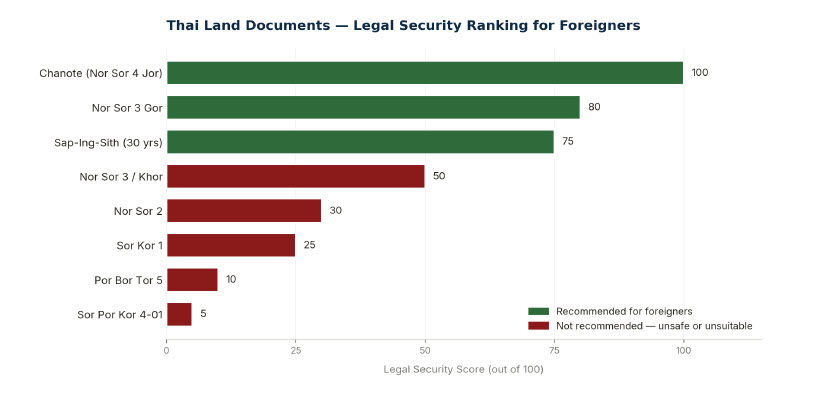
At a Glance: Legal Security Ranking
Where each Thai land document sits on the security spectrum for a foreign investor. Only the
top three (in green) belong in any expat property deal.
1. Chanote (Nor Sor 4 Jor) — โฉนดที่ดิน
The Chanote is the highest and only true land ownership title in Thailand. It is issued by the
Department of Lands using GPS-based surveying, tied to the national geodetic grid, and
marked by numbered concrete posts in the ground. The Garuda emblem on the deed is red.
• Full freehold ownership — sellable, mortgageable, subdivisible, leasable.
• Precise boundaries — no surveying disputes.
• Accepted by Thai banks as mortgage collateral.
• Eligible for Sap-Ing-Sith, lease, usufruct, and superficies registration.
Expat takeaway: Always insist on a Chanote when buying through a Thai spouse, Thai
company, or when registering any long-term right in your favour.
2. Nor Sor 3 Gor — น.ส.๓ ก.
Nor Sor 3 Gor is a confirmed right of possession. The land has been aerial-surveyed and
parcel points recorded. The Garuda emblem is typically green.
• Can be sold, leased, mortgaged, and subdivided.
• No 30-day public notice required for sale.
• Upgradable to Chanote in most provinces (3–12 months).
Expat takeaway: Acceptable for residential purchases, but always plan and budget for an
upgrade to Chanote.

3. Sap-Ing-Sith — ทรัพย์อิงสิทธิ
Introduced by the Sap-Ing-Sith Act B.E. 2562 (2019), Sap-Ing-Sith is a registered real right
allowing a holder — including a foreigner — to use Chanote-titled land or a condominium for a
fixed term of up to 30 years. It is transferable, inheritable, and registered at the Land Office.
• Created only over Chanote land or eligible condominium units.
• Not a substitute for ownership — the land itself must remain Thai-owned.
• 30 years is the statutory maximum. “30+30” or “60-year” promises are not enforceable.
• More flexible than a standard lease: freely transferable and can be used as mortgage
security.
Expat takeaway: A genuinely useful long-term option for foreigners, provided it is properly
drafted and registered. Treat any “foreign ownership” marketing label with great caution.
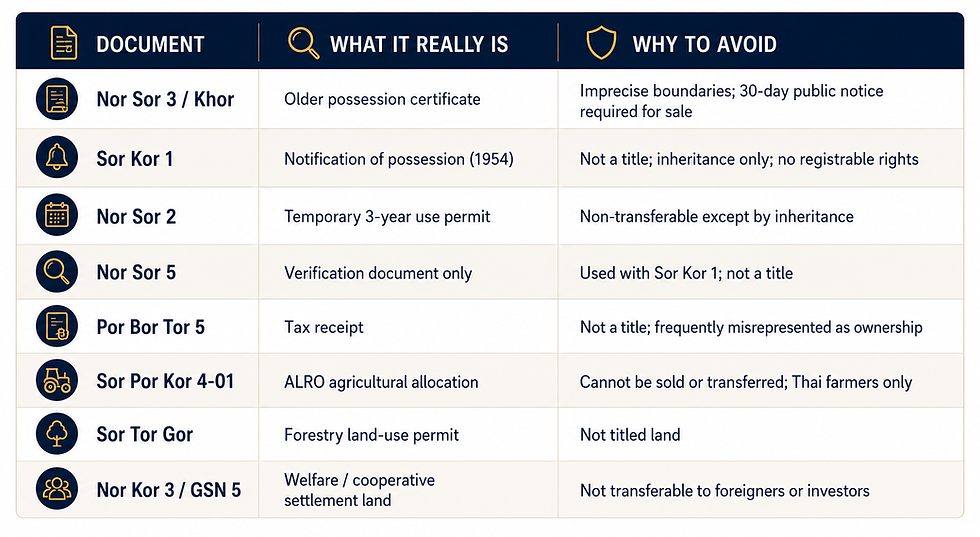
Documents to Avoid
Each of the documents below is commonly misrepresented to foreign buyers. None confer
ownership, and none should be accepted as the basis for a foreign investment.
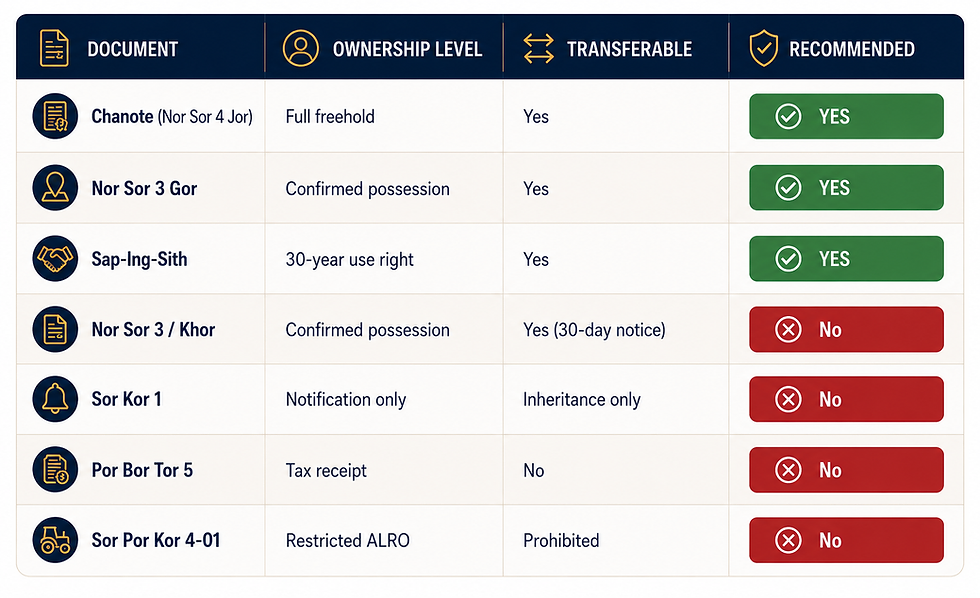
Quick Comparison: Recommended vs Not
Due-Diligence Checklist
Before you sign anything or transfer any money, your lawyer should have:
• Obtained a certified copy of the title deed from the relevant Land Office.
• Verified the owner's identity against Thai government records.
• Checked for registered encumbrances (mortgages, leases, usufructs, court orders).
• Confirmed the type of title and whether an upgrade is possible.
• Cross-checked the parcel against the Land Department's map (no forestry, ALRO, or State
land).
• Inspected the physical land and confirmed boundary markers match the deed.
• Confirmed seller authority (sole owner, joint consent, or court permission for inherited
estates).
Frequently Asked Questions
Q: Can a foreigner own land in Thailand?
A: No. As a general rule, foreigners cannot own land in Thailand. A foreigner may, however,
own a condominium unit freehold within the 49% foreign quota, and may hold registered rights — lease, usufruct, superficies, or Sap-Ing-Sith — over Thai-owned land.
Q: Which land titles should a foreigner consider?
A: Only three — Chanote (Nor Sor 4 Jor), Nor Sor 3 Gor, and Sap-Ing-Sith registered over
Chanote land. Everything else is unsuitable for foreign investment.
Q: Can I buy land through a Thai company?
A: Only a properly structured Thai company with genuine Thai shareholders and real business operations may hold land. Nominee structures — where Thai shareholders hold shares purely on a foreigner's behalf — are illegal under Thai law and can lead to forfeiture of the land. Always seek qualified legal advice.
Q: Can my Thai spouse buy land?
A: Yes. A Thai spouse may purchase and hold land in their sole name. The Land Office will
require both spouses to sign a joint declaration confirming that the funds used belong to the
Thai spouse personally. A foreign spouse may protect their position with a usufruct,
superficies, or registered 30-year lease.
Q: What is the difference between a lease and a Sap-Ing-Sith?
A: A standard lease is a contractual right registered against the land for up to 30 years.
Sap-Ing-Sith is a registered real right (in rem) introduced in 2019, also for up to 30 years, but it is freely transferable, inheritable, and can be used as mortgage security — making it more
flexible than a lease for long-term foreign investment.
Q: Is Por Bor Tor 5 a land title deed?
A: No. Por Bor Tor 5 is a tax receipt only. It confers no ownership and no registrable rights. Be very cautious of any seller presenting one as proof of ownership.
Q: Can Nor Sor 3 land be upgraded to a Chanote?
A: In many cases, yes — depending on location and survey availability. Our team handles these upgrades regularly and can advise on timing and cost.
Q: What is the strongest land title in Thailand?
A: The Chanote (Nor Sor 4 Jor). It is GPS-surveyed, recognised by Thai banks and courts, and
the only deed conferring full freehold ownership.
Q: How do I verify a Thai land title before buying?
A: Send the title deed to a qualified Thai property lawyer. We will obtain a certified copy from the Land Office, check for registered encumbrances (mortgages, leases, court orders),
confirm the seller's authority, and inspect the physical boundaries against the deed.
Q: What about 30+30+30 lease arrangements?
A: The Thai Supreme Court has confirmed that only the first registered 30-year lease term is
legally enforceable. Contractual promises to renew are not binding on successors or third
parties. Treat any '60 or 90-year lease' marketing as a personal promise, not a real right.
Why Lawyers for Expats Thailand
Lawyers for Expats Thailand is the dedicated law firm for foreigners wishing to invest in
property in Thailand. We work exclusively with international clients. Every Chanote we review, every Nor Sor 3 Gor we upgrade, every Sap-Ing-Sith we register — it is for an expat client who needs the law explained clearly and applied safely. We do not act for developers, agents, or seller-side intermediaries. Our duty is to the foreign buyer alone.
About the Author
Kanokpich Ukritdutsadee, widely known as Lawyer Pook, is a Thai lawyer and barrister and the head and managing director of Lawyers for Expats Thailand. With over 21 years of qualification and practice, she has dedicated her career to the legal needs of foreigners living, working, and investing in Thailand — property, visas, business setup, family law, wills, and litigation. Her practice is built on a single principle: foreigners deserve clear, honest, and protective legal advice in their own language.
What We Do for Property Investors
• Pre-purchase title due diligence — certified Land Office checks, encumbrance searches,
boundary verification.
• Drafting and reviewing Sale & Purchase Agreements and reservation contracts.
• Nor Sor 3 Gor to Chanote upgrade applications.
• 30-year leases, usufructs, superficies, and Sap-Ing-Sith drafting and registration.
• Thai company formation for property holding — compliant, audited, no nominee structures.
• Condominium freehold purchases under the 49% foreign quota.
• Wills, succession, and estate transfer for property in Thailand; property disputes and
litigation nationwide.
Call or WhatsApp: +66 95 658 3038


Comments