


The Nominee Crackdown: Understanding Why It Is Happening

By Kanokpich Ukritdutsadee, Head of Lawyers for Expats Thailand
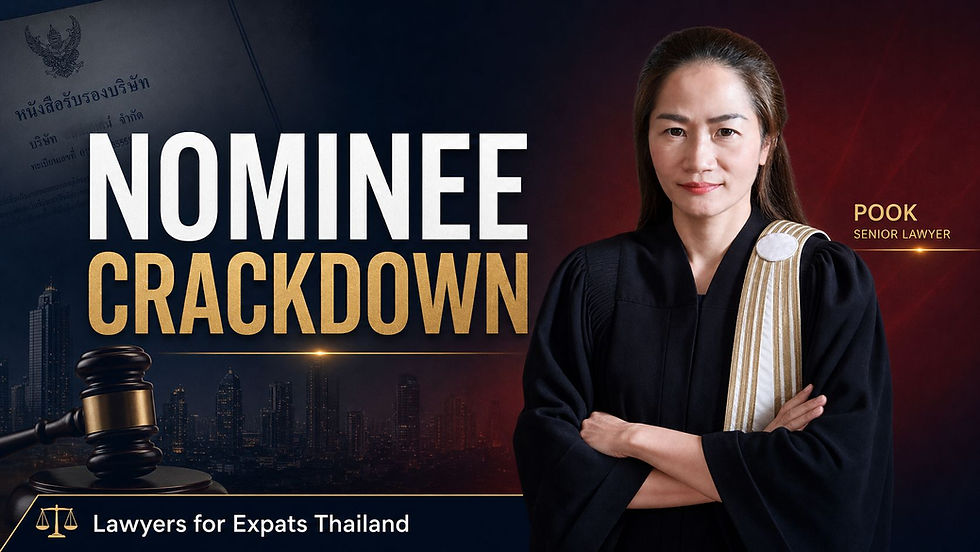
There is one subject dominating conversations among foreigners doing business and owning property in Thailand right now, and that is the nationwide crackdown on nominee structures. For years we at Lawyers for Expats Thailand have warned that this day would come. It has now arrived. In this article I want to explain, in plain language, what a nominee is, why the government is acting, and what foreigners and the Thai nationals who help them should understand about their real exposure.
FIRST, WHAT IS A NOMINEE?
A nominee is a person who is placed on paper as an owner or shareholder of a company, or as the holder of an asset, but who is not the real owner. The nominee holds the position on behalf of somebody else, usually a foreigner, in order to make an arrangement look legal when in substance it is not.
In Thai law this is not a grey area. The Foreign Business Act B.E. 2542 (1999) prohibits the use of Thai nationals as nominees to conceal foreign ownership or control of a business. Section 36 of that Act makes it a criminal offence for a Thai national to act as a nominee, and Section 37 imposes equivalent liability on the foreigner who uses the structure. The penalties include imprisonment of up to three years, a fine of between 100,000 and 1,000,000 baht, or both.
We have been saying this for many years. The structures were common, they were quietly accepted, and many people were told not to worry because the authorities supposedly did not have the means to detect them. That assumption was always wrong, and in 2026 it has been proven wrong.
TYPICAL NOMINEE STRUCTURE NUMBER ONE: THE FOREIGN-RUN BUSINESS
The first and most common nominee structure involves a foreigner who runs or owns a business but uses Thai shareholders who never actually invested any money into the company.
On paper the company looks compliant. Thai nationals hold the majority of the shares, so the company appears to be Thai-controlled and therefore entitled to operate in sectors restricted to foreigners. In reality the foreigner controls everything. The foreigner runs the business as if it is entirely his or her own. The Thai shareholders contributed no capital, they take no part in decisions, and they receive no dividends, because they are only shareholders on paper. They are there to make the numbers work, nothing more.
This is precisely the arrangement the law was written to stop, and it is exactly what the authorities are now hunting for.
TYPICAL NOMINEE STRUCTURE NUMBER TWO: FOREIGNERS AND PROPERTY
The second common structure involves land. Under Thai law a foreigner cannot own land. To get around this, a company is created with Thai nominee shareholders, and that company buys the land. Because the company is, on paper, majority Thai-owned, it is allowed to hold the title. The foreigner then controls the company and therefore controls the land in everything but name.
The Land Code addresses this directly. Sections 97 and 98 define when a company is to be treated as foreign, and Sections 111, 112 and 113 create criminal liability for foreigners holding land unlawfully and for any person who acquires land as the representative or agent of a foreigner. Where a foreigner is found to hold land in breach of the Code, Section 94 allows the authorities to order the land sold within a period of not less than 180 days and not more than one year. If the owner does not sell, the Director-General of the Department of Lands can order a forced sale at a price the owner has no control over.
WHY THE CRACKDOWN IS HAPPENING NOW
The crackdown is happening because the government has changed its entire method. For years compliance was checked on paper. If the documents looked correct, the matter was closed. That era is over. Thailand has shifted from form-based verification to substance-based verification, and that single change is what makes today different from every warning that came before.
Since 1 January 2026, Thai shareholders in companies with foreign involvement have been required to provide personal bank statements covering the months before they paid for their shares, to prove the money was genuinely their own. Since 1 April 2026, certain company changes, such as appointing a foreign director with signing authority or reducing foreign partners below the fifty percent threshold, trigger a mandatory confirmation of genuine investment and can lead to an interview with the Department of Business Development.
Behind this sits a coordinated effort across many agencies. The Department of Business Development, the Department of Lands, the Department of Special Investigation, Immigration, the Revenue Department and the Anti-Money Laundering Office are now linking their databases. Corporate registries and land registries have been synchronised, so the system can automatically check whether a company's registered capital matches the value of the land it holds. A mismatch triggers a forensic audit. On 15 May 2026 the Department of Lands issued an urgent circular directing every provincial governor to step up enforcement and to examine mixed-capital companies on a monthly basis.
In short, the authorities now have both the legal tools and the technology to see what they could not see before.
THE CRACKDOWN IS NATIONWIDE
This is not confined to one province. It began on the islands of Koh Samui and Koh Phangan and in Phuket, and it is expanding to Pattaya, Krabi, Phang Nga, Hua Hin, Chiang Mai and beyond. The Department of Business Development has identified tens of thousands of suspect companies in the major tourist areas alone, and has spoken of preparing to investigate around 21,000 foreign-linked cases focused on real estate, agricultural land and residential property.
The pattern is consistent everywhere. Companies are flagged by data analysis, high-risk firms are referred for investigation, raids follow, and arrests, seizures and prosecutions come after that.
SHOULD FOREIGNERS AND THAI NOMINEES BE WORRIED?
If you are a foreigner running a business through Thai shareholders who never invested, or holding land through a company built on nominees, then yes, you should take this seriously. And if you are a Thai national who agreed to be a shareholder in a business you have no real connection to, you should understand that you carry personal criminal liability under the Foreign Business Act. The authorities are now interviewing Thai shareholders specifically to find out whether they genuinely invested and whether they understand the business they supposedly own.
The consequences are real. They include forced sale or seizure of land and property, company closure, criminal prosecution, heavy fines, and for foreigners the possibility of deportation and blacklisting. The authorities have also made clear they are targeting the facilitators, meaning the law firms and accounting offices that set up these structures.
LOOK AT THE NEWS. THIS IS NO LONGER A THREAT.
I want to be very direct about this. This is not a warning about something that might happen one day. It is happening now, and the news proves it.
In May 2026, police carried out raids on Koh Phangan, searching dozens of companies and several law and accounting offices, arresting suspects and seizing land. In a single second-phase operation on the island, authorities arrested 22 foreigners and seized more than 40 rai of land worth over 200 million baht. The Department of Special Investigation opened a probe into 34 companies on Koh Samui and Koh Phangan suspected of using Thai nominees, around 20 of which held assets exceeding 100 million baht. In Phuket, operations have involved more than 200 suspects and asset seizures running into the billions of baht. In one case a single Thai national was found listed as a shareholder in 87 separate companies.
These are not rumours. They are recorded events, reported in the Thai and international press, with names, dates, arrests and seizures attached.
WHAT YOU SHOULD DO
If any part of this article describes your situation, do not wait for a letter, an interview request, or a raid. The time to review your structure and bring it into genuine compliance is before the authorities reach you, not after. There are legitimate, lawful ways for foreigners to operate businesses and hold property interests in Thailand, and the right path depends on your specific circumstances. The wrong move now, made in panic, can make matters worse.
We have advised foreigners and their families on exactly these issues for many years, and we warned this crackdown was coming long before it arrived. If you are uncertain about your position, the responsible step is to get clear, confidential advice on where you actually stand.
CALL US

If you have any concern about a nominee structure in your business or your property holdings, contact Lawyers for Expats Thailand today for a confidential discussion.
Call +66 95 658 3038


Comments